
Nairobi, June 2-11
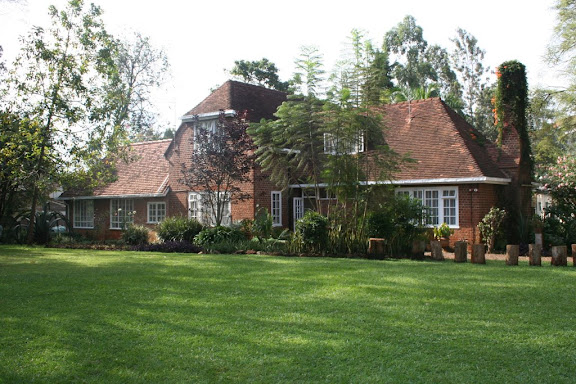
The guest house where we are staying is just past the bend on a private street. It is a beautiful old house, a relic of England’s colonial stay here in Kenya: gabled and tiled roof, mullioned windows, gardens blooming and old trees bending over the lawn.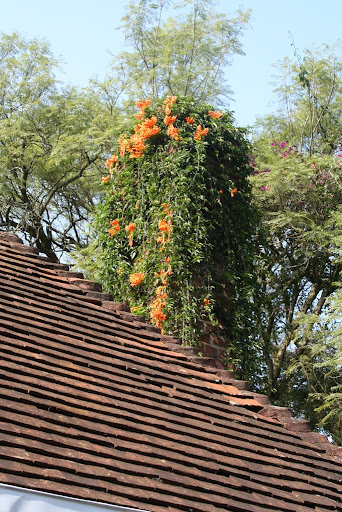
The yard itself is framed with very tall bushes, and I’m told (though I haven’t gone looking) that razor wire is hidden amongst the leaves. The gate on the driveway is kept locked: to go in and out, one must summon the guard who has a tall little house just inside the gate. He lets us in and out when we leave in the matatus, and he lets us in and out when we go for a walk or run.
This is not the first gate one must pass through to reach Musmark, however. The street itself is gated, and it, too, is opened by more than one guard who keep their post just on the inside.
Security is priority in Kenya. And I guess it’s priority everywhere, but it makes itself painfully obvious here. Walls surround every house, every property, it seems, and these are walls whose tops are then covered by razor or electric wire or, more commonly in poor communities, broken pieces of jagged glass embedded in their tops.
Every day we pass a company building that advertises their products in banners: “Alarms,” “Guards,” “Dogs,” they say.
We have dogs at Musmark. Curfew is ten p.m., and after that we hear the guard dogs on the lawn. Sometimes they are barking, and sometimes we hear them running around.
It’s a good feeling to know they’re out there.
So it’s safe here where we are. But it feels like a different kind of safe from the one we enjoy in the U.S.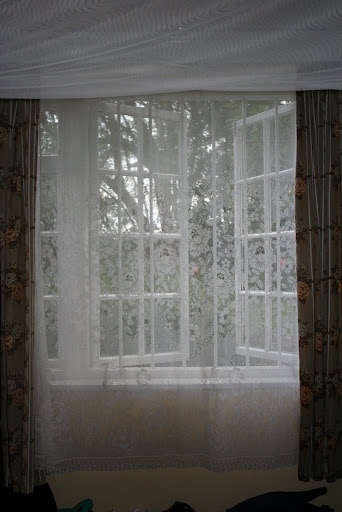
The view from our bed at Musmark. See the mosquito net at the top of the frame? It folded up around the four posters and made a canopy during the day.


