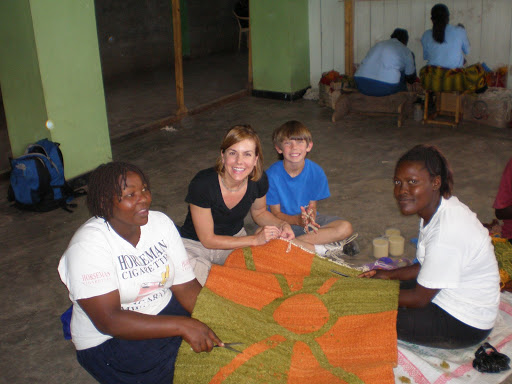
Weaving Tuesday, June 05, 2007
We had our choice today at Beacon of Hope. We could work with the children; we could work in the clinic; we could work with the women who weave.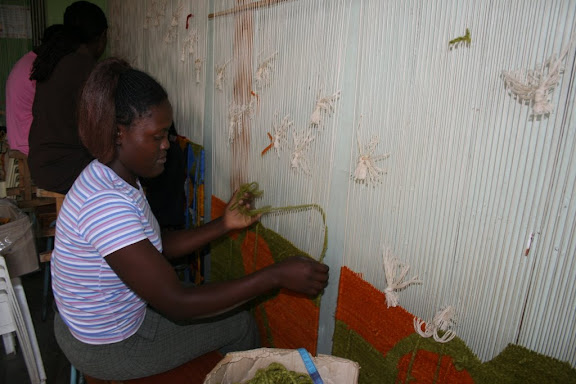
Beacon has always meant “weaving” to me. That was the first thing I knew of Beacon of Hope: women infected and affected with HIV/AIDS who wove rugs to make a living and be a part of a community. I chose to weave today.
The weaving room is open to the hallway on one side. Women sit in this hall, carding or running wool through a spinning wheel. In the weaving room proper, eight foot tall looms stand against two perpendicular walls. I went to one corner where Mary was at work. Sun fell through the high windows into the room, and the corner where she worked was bright with it.
Mary sat on a bench turned on its side. She was working at the bottom of the rug, adding a green section to a triangle shape that was divided into two colors: green on one side and orange on the other. “Sunburst,” she said to me and Emma when she felt us watching. “This is called ‘Sunburst,” she said, and we knew it was the name of the design.
Emma and I leaned down to watch. Tight pairs of threads run the course of the loom’s length, sections of which are tied with looped strings. Pull one of these loops and the several sections come forward together. It is behind these that you pass the thick strand of dyed wool. When you reach the end of that line, you wrap the strand around the last set of strings and pass the strand behind the opposite strings.
Mary demonstrated this with a few quick gestures. “Like this,” she said. “And this.” She pulled the looped strings. “Use this hand when you go this way,” and “Use this hand when you go this way.”
It all sounded so simple, but I wasn’t at all certain I could get it. Still, she had moved over on her bench, so Emma Grace and I squatted down and tried to make it work. The portion we were working on was only three or so inches wide, but we managed to mess up twice in the first two rows, so that Mary instructed us to redo it.
Not a little humbling, that.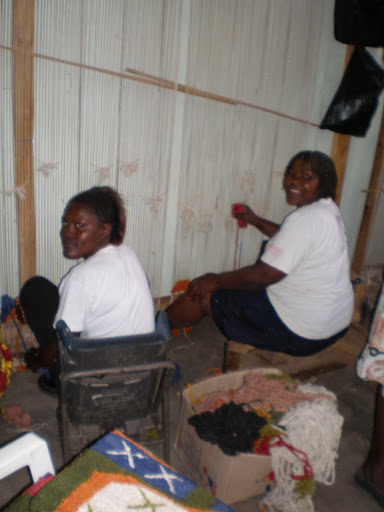
But we kept trying. Taking turns, Emma Grace and I pulled on strings and pulled on yarn and made loud, encouraging comments. “You’re doing great, Momma!” “Wow, Emma Grace, I think you’re better at this than I am.” Our three inches grew a layer or two thicker. Next to us, Mary continued to work in silence.
We completed a row or two more, and I began to think I might actually understand it and, more importantly, have discovered a Rhythm. For Emma Grace, however, the initial fascination went rapidly from Just Watching to Honest Boredom. “I want to do something else, Momma,” she said.
I wanted to help her find something else, but this weaving thing really held me. I was just on the cusp of Getting It, and I didn’t want to quit. Also, I didn’t want to disappoint Mary, who had taken time More Than Once to help me find my way. I was, to be honest, afraid of being considered a Tourist, a stupid Mzungu (white person), who neither knew nor cared about weaving.
I am (in some respects) a tourist, and I can’t help the Mzungu part, but I Really Am Interested in weaving, especially at Beacon of Hope.
Emma Grace found her way to the playground, and I gave myself fully to the task at my hands. Mary worked quietly next to me, but I felt as if I’d earned something (what? Invisibility? Or camaraderie?) when she Leaned Across My Lap to get more yarn from the cardboard box at my elbow. And later, when I messed up the weaving Yet Again, she was in my lap again, showing me where my mistake lay.
Oh me. How to say “I’m sorry” in Swahili? But Mary had some English. “I’m sorry, 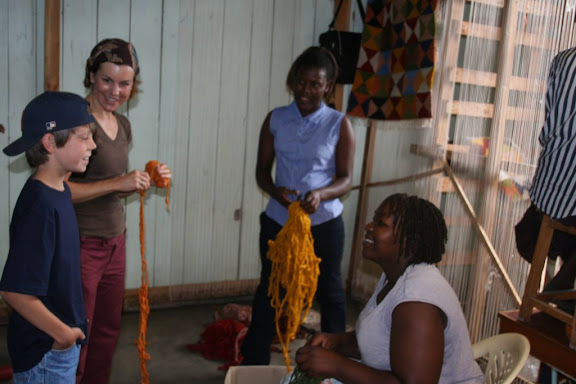 Mary,” I said, and she smiled at me—a full smile, eyes wrinkled at the corners. “It’s okay. It’s okay.” She said. And then she said, “You sit here. That part too hard.”
And so we traded seats. After all, she was working on a section of orange yarn that was several inches wide, while my narrow green section required lots of turn-arounds, lots of drawing one thread of the pair of vertical threads, lots of decisions. I was wanting to reach a mindless place in this weaving, and was finding that elusive. I needed to be making No Decisions about this rug.
So we switched seats, and now I was between Mary and Eunice. The wide section of orange yarn loosened my tongue, and I had noticed that Eunice’s English was rather strong. “Teach me Swahili,” I said. Eunice and Mary thought that was pretty funny, but they tried to teach me anyway.
They taught me “Good Morning,” and “Good Afternoon.” They taught me “My name is Rebecca,” and, at my request and their apparent amusement, how one says, “soft,” and “hard,” and “easy.” I said the Swahili words over and over again to myself. I tried to make sense of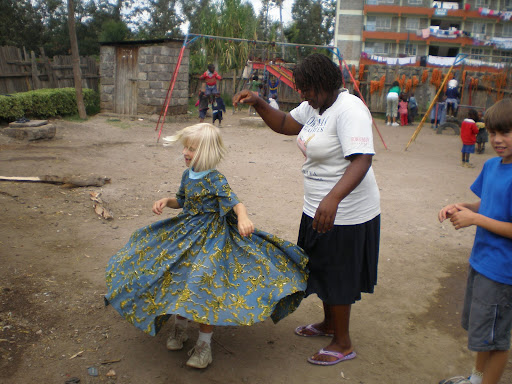 them, to hang meaning on their syllables that would help me remember, but I’ve retained nothing. Learning Swahili is learning a language that, unlike Spanish or French or German, is Entirely New. There is nothing to assimilate it to, if one is an English speaker. It Isn’t Easy.
But Mary and Eunice kept trying, and in between this and the continued corrections in my weaving (the rug must be at all times 30 inches wide and, if you pull the yarn too tight, you will shrink its width. This is easy to do, especially if you are a nervous and over-eager Mzungu), I learned that Mary has three children and Eunice has none, and they learned that I have three children and am from A-mer-ee-ca, and North Ca-ro-lee-na, to be specific.
I was called away then. We were having tea and a meeting in the back room. While there, I made certain to find out from our more experienced travelers exactly how one says “I’m sorry” in Swahili. It’s “pole” and is pronounced with two syllables, like Mexican “mole” sauce. And if you’re really sorry, you can say “pole sana.” I thought these would be good words for a Mzungu Wanna-Be Weaver to arm herself with, especially when Mary is allowing you to work on her rug.
When I got back to my weaving, she was pulling out threads at a rapid rate. Oh dear. I tried my new words immediately. “Pole sana,” I said. “No, no,” said Mary. And she explained that the mistake wasn’t mine, but hers. She’d made a mistake in the recreation of the design, and both sides would have to be pulled out—my orange and her green. It wasn’t my fault, she explained. It was a mistake.
“When you are a weaver,” she said, “you weave and you undo.” She didn’t seem bothered at all by this undoing, but sat and undid just as fast as she had been weaving earlier. So I joined her, pulling out my orange yarn not quite as deftly as she pulled her green.
The three of us went back to our Swahili lesson, but I also repeated Mary’s wisdom a time or two: When you are weaver, you weave and you undo. There’s a metaphor in that somewhere, I think. And I undid and I undid, sitting there on my bench between these two friends, and I noticed that the light had shifted, and the African sun was slowly running its course through the weaving room.