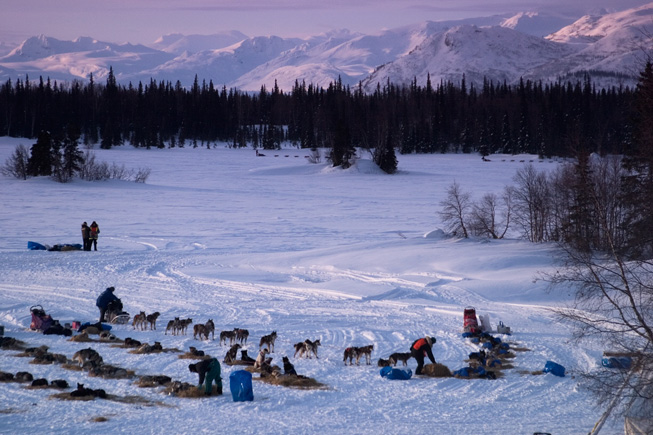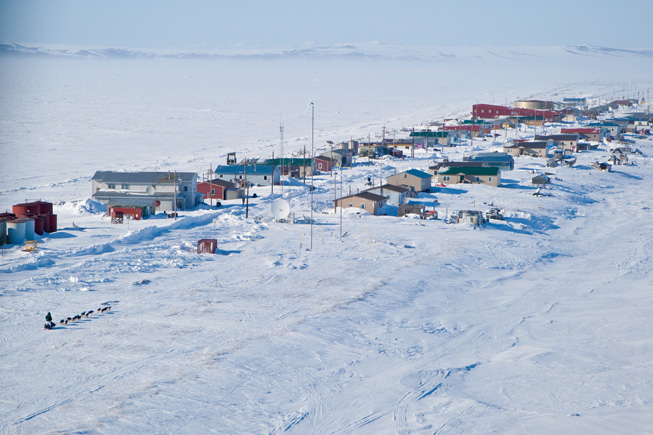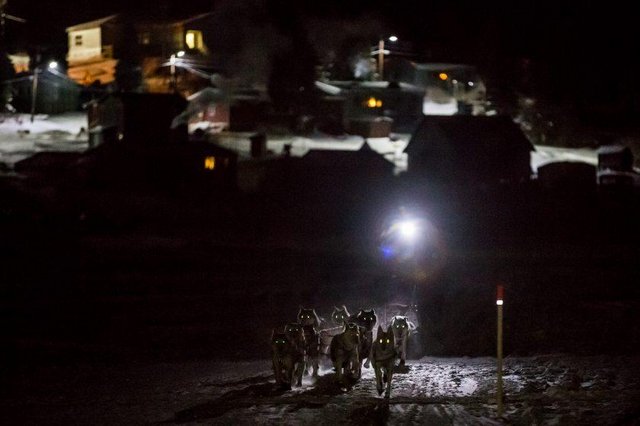
It started last Sunday, the first Sunday in March, as it always does and has since 1973. “The Last Great Race,” they call it. The Iditarod.
You’ve heard of it, I think: a sled-dog race. Not the only one there is, mind you, but the one best known. A race among sled dogs and their mushers, each team taking on the 1,049 miles of Alaskan wilderness that lie between Anchorage and Nome. The idea is to get there, but also, of course, to get there first– to that (by all standards) tiny town on the coast of the Bering Sea.
The Bering Sea? Even the name makes you chilly. We dwellers of the Lower 48 might be vaguely aware of its existence. We might guess, when pressed, that it houses whales or ice floes. But the fact of its coldness is of no more consequence than the coldness that is Alaska at this time of year. Alaska is all snow in March, and has been for some time. Its snow is feet deep and thickly packed; its rivers are frozen solid. For hundreds of miles it is all ice and snow and driving wind, and the sled dogs wouldn’t have it any other way. The Bering Sea is as good a destination as any, and on Sunday, March 3, over 1,000 dogs set out to get there, packed in teams of sixteen, each of them pulling their best friend.
The dogs are trained for this; they are eager to get started. We watched them hoofing it (pawing it?) out of Willow, and the dogs were strictly business, nothing but thrilled, it would seem, to be out on the snow-buried ice, living for nothing other than to head into the wild.
From the outset, it seems an improbable endeavor. Sixteen dogs and one human being, a sled and dogs both surprisingly small. I couldn’t believe how small the dogs were, in fact. I had banked on Siberian huskies or something equally furred and sizeable to take on what lay ahead. But the dogs were uniformly smallish. They wore booties and harnesses; they wore their tongues hanging out to the side. And they were running, eyes (blue or brown or both) fixed on the trail ahead– a trail comprised merely of a long white furrow in the otherwise white landscape of snow.
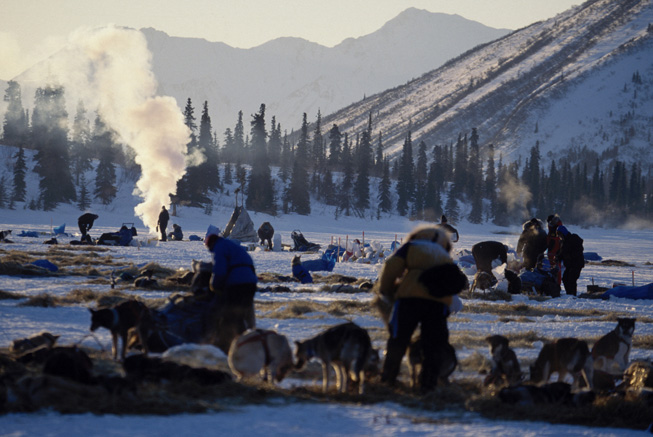
One can only wonder at it. What could take hold of you to make you want to do something like this? At the very least, one must be passionate about dogs. Which, of course, these mushers are. They breed the dogs, train the dogs, know the dogs, love their dogs. Exhausted at checkpoints, they are nonetheless checking on their dogs, massaging sore shoulders and, sometimes, leaving behind in safety the ones who, this time, can’t make it.
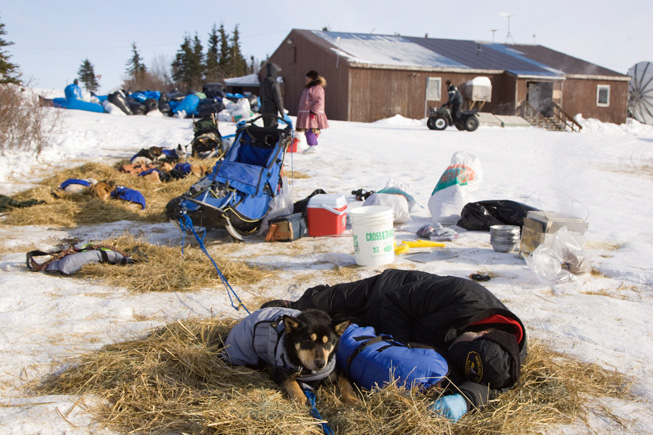
And there’s got to be, I would think, a love of the freedom; the wild; the wide open space and the silence; the unfettered, unmarred, crushing beauty of the harshest landscape; a willingness to be cold for a Long Time.
I am a new student of the Iditarod, but a very real fan. Who wouldn’t be? Again I put to you the improbability of this enterprise. It is a race to the finish; like the Olympics, the participants see training as their full-time job. But where Olympic competition presents its dangers, the interior of Alaska– in winter, at the very least– can easily take your life.
The terminology alone serves as warning: the state has an “interior.” North Carolina has an “interior,” I suppose, and I suppose I live in it. It’s better known as “the Piedmont” and has any number of shopping malls. But when you speak of the Alaskan Interior, you mean someplace harrowing and relatively unvisited– with good reason. There are checkpoints on the trail with a residential population of 2. Two. See what I mean?
Take the “town” of Ophir. Named by a gold prospector who knew his Bible, Ophir is now a ghost town. Iditarod.com reports that one can still find artifacts there from the gold-digging days. Artifacts. Any artifacts you’d find in my town would be something with a food label, or a wind-blown bag from the grocery store. Not Ophir. The town is abandoned. Entirely Empty. If you get quiet right now, I’ll bet you can hear the wind whistling through it. No One Lives There. Where is the uninhabited ghost town nearest you?
Other names of the Iditarod also speak volumes. This year’s route includes stops in Yentna and Skwentna, Takotna and Shageluk and Shaktoolik. The words ring with the age-old cultures who make lives within– not in spite of– the harsh landscape. There’s nothing in them that’s been done over in a neo-classical style. Not much paved. The town of Anvik is a prized destination. Population 82, it boasts 2 stores and the Millenium Alaska Hotel, where the first musher to arrive in the Iditarod is treated to a seven-course meal.
Only a few checkpoints on this year’s course have what might be called “western” titles, but even these don’t shake the shadow of dangerous environs. Examples? “Rainy Pass” and “Safety.” Most teams make their required 24-hour stop at Rohn, which is known as the “gateway to the interior,” and which marks the last stop before the “bleak but treacherous Farewell Burn area” (Iditarod.com). Bleak but treacherous. Those are some adjectives worthy of consideration before one, say, hies across it alone with a team of sled dogs.
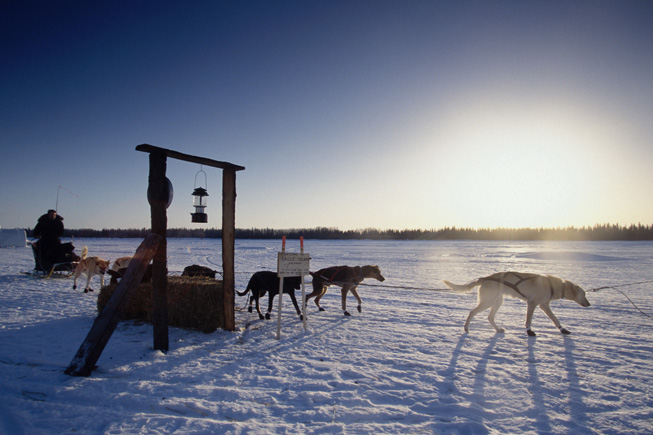
And yet they go. Annually. Between the checkpoints Grayling and Kaltag lie 130 miles of entirely unvillaged snow. The winds on the Yukon River are bitingly cold. Ice hangs in the beards and mustaches of the men. They travel for hours and days at a time. Other than the two required stops (1 24-hour, 1 8-hour), they continue as long as they’d like between checkpoints, for as long as they can. The slowest recorded time to the finish stands at 20 days; the fastest? 8 days, 22 hours, 46 minutes, and 2 seconds.
Late last night, Mitch Seavey was the first in 2013 to pull into Nome. He had ten of his dogs with him, and the team had made it in 9 days, 7 hours, 39 minutes and 56 seconds. Aliy Zirkle was right behind him, also with ten of her team. The race is over 1000 miles long, across some of the most treacherous ground on earth, and she got to Nome only 20 minutes behind him.
It isn’t over yet. Nineteen teams are still out there, and the Iditarod won’t shut down until the last one is in.
On Sunday, we stood on the frozen lake in Willow and cheered the teams on as they headed out into the wild. We stayed to watch the first thirty teams or so go by, our Alaskan relatives identifying to us the mushers they knew of, the ones who have won before, the ones who have raced for years and years. We watched and cheered until the cold crept through our snow pants and up the bottoms of our bunny boots, until we wanted to go get warm again.
But I’m pretty sure it was Aliy Zirkle I remember, one of the several women who glided by behind their dogs. She was grinning behind her goggles, her cheeks dimpled, her hair in braids. For her, as for all of the mushers, the sixteen dogs in front of her each had a name, a personality, and, like her, an appetite for something that you just can’t find in stores.
I watched her team glide away from me, sliding smoothly over the ice. And then they made the obligatory hard right at the hill and disappeared between the trees.