
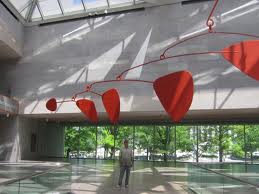
Form
A few weeks ago, I took my kids to the Alexander Calder exhibit at Duke’s Nasher Museum. This was the second of our “Mom-days,” a little summer practice I instituted last year when it became suddenly clear to me that, if I did not deliberately claim just a wee bit of my children’s time once a week, I wasn’t going to get any of it. It’s just one day, and it’s really only part of one, but I do ask of my children (ages 15, 13, 11) this: that we set aside one day of the week to make plans with no one else so that we can do something together. They are amenable to it, and for that I’m grateful, and on Tuesday, June 12, I took them to the Calder exhibit (Form, Balance, Joy) at the Nasher, just six days before the exhibit closed.
Of course before we went to the museum, we had lunch together at Bojangles. I have only had a meal here one other time, and this was nearly six years ago. It’s the Yankee in me (if not the careful eater) that avoids it: to my mind, Bojangles just doesn’t appeal. But while my children are Duke fans by breeding, they are nonetheless Tarheels by birth, and Bojangles, to them, is Important. And so our June 12th Mom-day found us serving both the quotidian and divine (Calder being the divine part), and that was a good thing. We all of us enjoyed a surfeit of sweet tea.
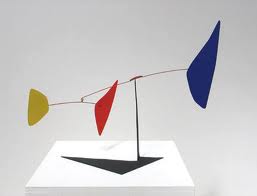
Balance
We had been together at the Nasher only one other time, and I reminded my children of this as we drove to Duke’s campus. It was a rainy day in the fall of 2005, and the newborn museum was only a few weeks open. I got in on my student discount, and the children were so much younger then– a fact made glaringly obvious by Will’s almost instant antic: he leapt in the air to touch the whiskers on the giant hanging sculpture of a human head. Never mind that the signs all asked us not to touch anything– Will was 9 years old at the time and was constantly leaping to touch things. Of course he instantly alarmed nearly every docent in the museum and had to show for his leaping prowess a bleeding index finger, because it turned out that the whiskers on the sculpture were Seriously Sharp. He nursed that finger throughout the entirety of our visit, sucking at the oozing blood, because the Nasher Museum is not in the habit of keeping bandaids on hand, and I didn’t have any either.
I reminded them of this as we drove to the museum, but they finished the story for me, and all of us hoped that the head would still be there, and I made them promise not to touch it. But it wasn’t there after all.
What was there was some of the work of Alexander Calder, a well-loved American artist of the 20th century, inventor of the mobile. In fact, the term mobile was coined for his work and then applied to the limitedly imaginative mobiles that hang above babies’ cribs. But if Calder was the initial inspiration, then that’s as far as it went: I have never seen hanging above a crib a work of art that displayed the delicate complexity and vision of Mr. Calder.
Here at the Nasher was his work, a room of wide-spread sculptures, works composed equally, it would seem, of concentration and whimsy, solid metal and invisible air. We knew not to touch them, but were warned too late not to blow on them: it took everything in us not to force air on Calder’s discs, plates, abstract planes of metal and then watch as they quietly answered, turning singly, in tandem, drawing invisibly at the thin and vertical interstices on which depended the entire piece.
We learned, after a while, to leave the sculptures alone and watch them– without deliberate interference– as they interacted with the air. Just walking near a sculpture brought (who knew?) some quiet gusts, and the reward was that slow, subtle and certain turning. It made you wonder at the wonder of Calder’s mind– that he should predict this, that one should think between the objects, that balance could be effected in just this way.
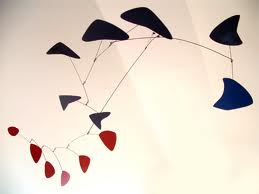
Joy
I loved it.
For my children, loving it was, perhaps, a bit of a stretch. The boys in particular took in the exhibit far more readily than I was prepared to do. They had scanned all that Calder in Durham had to offer while I was still enthralled with Les Mouettes (The Seagulls), which hung above our heads just inside the entry. A small part of me sagged just a bit: would this be all? I don’t want to bore them; I don’t want to teach them to hate art– and teaching someone to hate anything, even if you mean for them to love it, can so very easily be accomplished.
So I maintained my sense of humor; I entreated them to look again; I allowed them to tease me. And we did turn it into a game: I was impressed when Emma (without looking at the title) named Calder’s Snowflurries, “Snow,” and they all created somewhat of a game of walking past a sculpture and deciding whose “breeze” had made the thing move.
In the end, we were at the museum for just over an hour, I think, which was less than I had anticipated but also more than we had spent at Bojangles. Will, Everett and Emma were all of them cheerful as we left, but not because we were leaving, which I thought was a good sign. Everett had decidedly enjoyed the experience. The engineer in him has closely observed the working of things since he was a baby, and it was Everett who was most keenly interested that day in making the mobiles move. Emma insisted that we stop at the craft store on the way home: the entire experience had reignited her own desire to create art, and she needed more canvases and oil paints. And Will said as we left that he wanted to read something, something amazing, something that would blow his mind.
If seeing art doesn’t blow one’s mind– and not all art can blow everyone’s mind all the time– then it should, at the very least, make one hungry. But maybe not hungry for Bojangles.


