
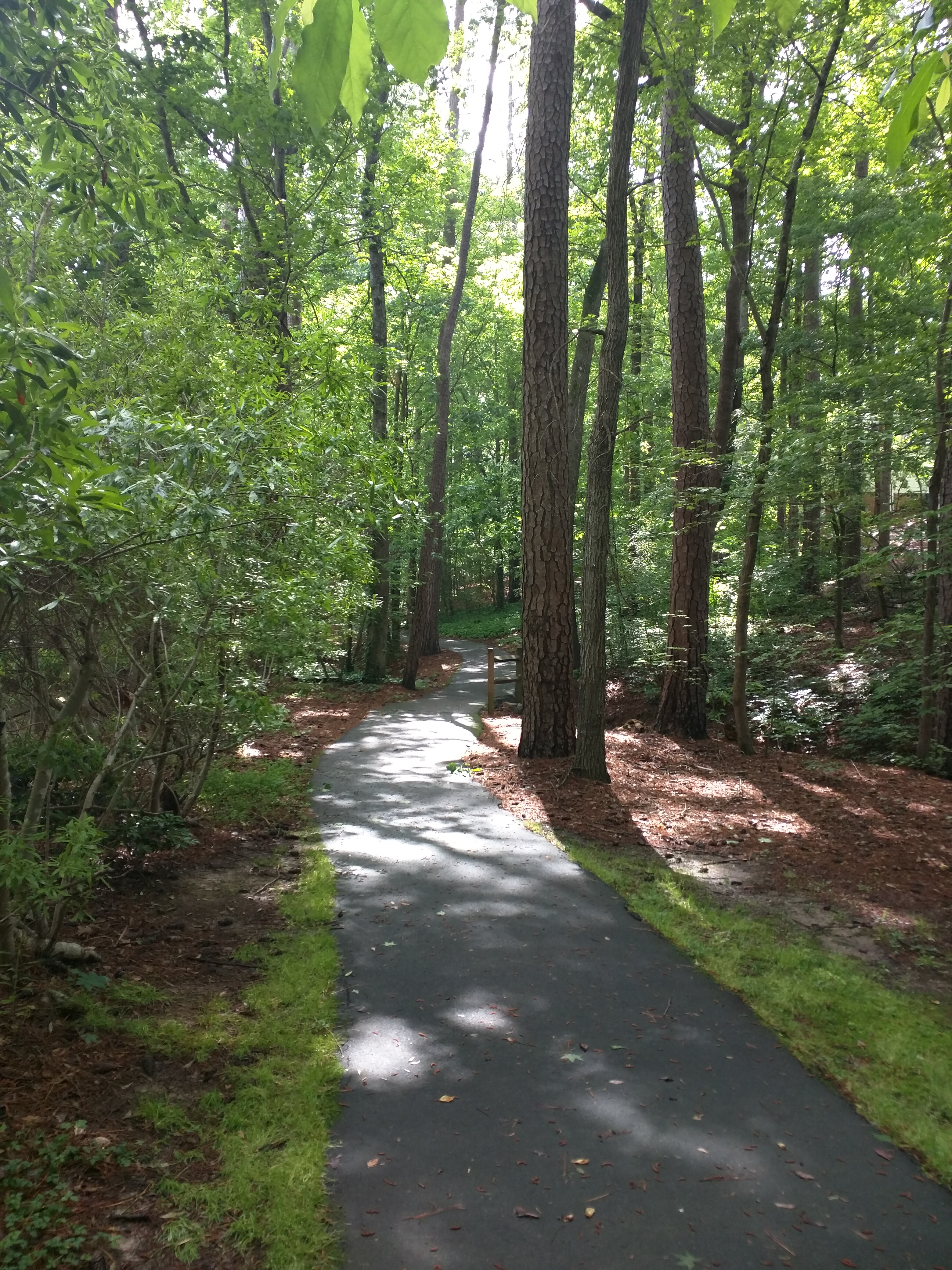
 See him:
Small boy in plaid shorts. Helmet. Sneakers. Socks pulled high on the shin. He is no more than four, maybe a little bit three.
He is trying to push his bicycle off the paved trail and into the pine straw, but only the front tire has made it. Rear tire and training wheels remain on the trail. The pine straw resists him.
Ten yards ahead, his father resists him, too. He has stopped his bike, has turned, is watching his son try to push his bicycle off the trail.
See him:
Tall. Sunglasses. Helmet. One foot on the ground, the other on a bicycle pedal. He watches his son, his body leans toward him. He is completely grown-up.
“No, Ari,” he says. “We’re not going to take the back way. We’re going around on the road.”
His voice is barely raised, but I hear him clearly–you and I hear him–though we are at least ten yards, maybe more, on the other side of Ari, who might be three years old, maybe four, who is (still) nudging his bicycle off the trail.
His father calls to him again: “This way,” he says.
I–we–imagine we see the predicament. The trail rises, has risen considerably already to the point where Ari is, and it rises further between him and his father, and further still beyond that. Not by a large degree, but it rises steadily. Maybe with legs as short as those, maybe with training wheels, maybe when one is barely four one feels one has come far enough. Perhaps one doesn’t wish to continue this climb. One sees that going the back way might be easier and infinitely better.
Perhaps this bike ride has been long enough.
“Come on, Ari,” the father calls. “You can do it,” he says.
Ari looks behind him. He sees us standing, waiting, where we have stopped walking the dog because we don’t want to impede the boy and his efforts, or those of his father.
And see us, standing there where we’ve been before:
Weary.
Because this struggle has gone on long enough. It’s been entirely enough. This pain, this wait. This persistent absence. This maddening relationship. This relentless trial that has us lying awake by night and anxiety-ridden by day. This not-enough-too-much-of-a-something. We are by all means now ready for the short-cut.
What is it we say? We who are nosing our bicycle-with-training-wheels off the trail, into the pine-straw, ready for the back-road to home?
We say, “Just teach me what I need to learn already so that this can be over.”
Ari turns back to his bike. He maneuvers front tire off pine straw, realigns bicycle to path. Climbs on.
We watch him. From this distance, we imagine we hear the chain clicking into place as Ari applies pressure to pedal. We see the tension lock in the little legs. We see the pedals resist.
“That’s it,” his father says, and the pedals move. Slowly, they glide forward and back. Once around. Twice. Ari’s body is taut. He makes small progress.
He gathers speed. Not that you would call it speed, but still. He is definitely on his way.
And then Ari feels it. We see it and stiffen, waiting. His father sees it too. The angle of the path has increased. The climb is harder here, if only just. Ari isn’t going fast enough. He cannot make it.
“You can do it,” his father says, and Ari stands on the pedals. Who knows how he knows, but he knows that this much will do: this greater effort, this harder work. Pedaling, standing, Ari reaches his father.
And he continues on. His father continues with him. Ari still struggles, but now father and son are pedaling side by side, and Ari’s father gives his son a gentle push, guiding him along as he pedals with his hand on his son’s back.
What lesson, I wonder, did Ari learn? What task ticked on his check-list? His legs are stronger for his effort. His confidence, too. Perhaps his sense of balance, or in the invaluable output of standing to push his best effort into his pedals?
But I wonder–we wonder–as we continue on with the dog, what makes us think that God is a checklist? A workbook? Where in His descriptors is the concept of God as manual?
We say, “Just teach me what I need to learn already so that this can be over.”
Because he is a series of lessons. He is a to-do list. Worse, he is an impediment to life lived as we prefer it.
He is forever getting in the way.
A perspective which might make us miss a thing or two about him: how he leans, how he calls. How he waits. How we might feel, if aware, the broad warmth of his hand, his gentle push, helping us up the hill.


